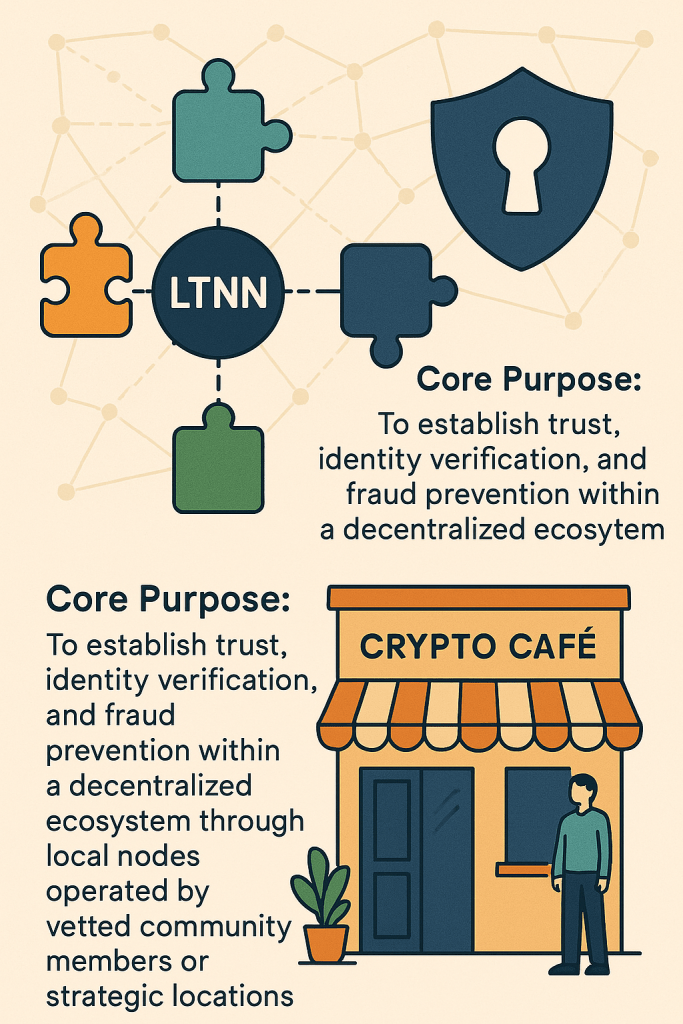
A LTNN is a physical and digital system that strengthens decentralized networks by anchoring them in real-world community hubs.
🔐 Core Purpose:
To establish trust, identity verification, and fraud prevention within a decentralized ecosystem—like XRPL—through local nodes operated by vetted community members or strategic locations for our Crypto Cafes. This is where you will be able to spend or swap your tokens within the cafe adorin community, and where you can keep your tokens safe as a store of value. If you want to sell your tokens you will be able to do that on the public exhanges, like coinbase, kraken, binance, etc.
⚙️ How It Works:
- Local Node Anchors: Each Crypto Café acts as a registered XRPL node—serving real people, not anonymous wallets.
- Identity Verification Layer: Customers opt into secure ID systems (biometrics, cryptographic credentials) to create trusted on-chain identities.
- Behavioral Trust Scoring: Nodes track engagement patterns (e.g., transaction reliability, dispute resolution) to build trust scores locally.
- Emergency Protocols: Nodes act as first-response units for fraud alerts or ledger anomalies—like neighborhood watch for XRPL.
- Offline to Online Bridge: Facilitates crypto onboarding for those without digital access, cementing real-world resilience and redundancy.
🔗 Why XRP Needs This:
In a system without centralized authority, localized nodes create social cohesion, offer defense against spoofing/attacks, and give the XRPL physical roots. It’s survival through trusted decentralization.
Here’s why:
- 🛡️ Security & Fraud Prevention: XRPL’s consensus is resilient, but banks face risks like Sybil attacks, validator misbehavior, and spoofing attempts. Localized nodes can verify identities and flag anomalies in real time.
- 🔍 Regulatory Compliance: Banks must meet KYC/AML standards. Physical trust nodes embedded in community hubs (like your café) can help bridge on-chain activity with verified off-chain identities.
- 🌐 Decentralized Resilience: Unlike centralized systems, XRPL relies on distributed validators. Banks benefit from geographically diverse, community-rooted nodes that reduce single points of failure.
- 🧠 Institutional Trust Building: As banks quietly build on XRPL for broader use cases—including tokenization and CBDCs—they’ll need real-world anchors to ensure integrity and public confidence.
📖 Chapter 1: XRP’s Moment of Truth
The world is watching. Can XRP become more than just a ledger?
🧭 A Brief History
XRP began as a vision for fast, low-cost, borderless payments. Built atop the XRP Ledger (XRPL), it offered transaction speed and energy efficiency that many competitors couldn’t match. The XRPL boasted decentralization, transparency, and consensus mechanisms tailored for financial-grade reliability.
Over the years:
- 2012–2016: RippleNet integration expanded institutional use
- 2017–2020: XRP saw explosive adoption during crypto’s first wave
- 2021–Present: Regulatory headwinds challenged legitimacy, sparking innovation among its community
🪨 Facing the Friction
Despite its promise, XRP faces a critical crossroads:
- Scaling Without Centralization XRPL’s validator network remains susceptible to geographic clustering and institutional dominance. → Solution: Inject local resiliency through community-powered trust.
- Trust Gaps in Validation Anonymous or unvetted validators open the door to Sybil attacks, spoofing, and manipulation. → Solution: Real-world identity layers with civic integration.
- Global Adoption Needs a Local Touch Crypto suffers from a disconnect with real-world communities. The “ledger of value” must reflect the lives and cultures of those who uphold it. → Solution: Enter the Localized Trust Node Network (LTNN)—where crypto meets community.
☕ Chapter 2: Café Vision
What if your favorite coffee spot was also the strongest node on XRPL?
🏛️ Enter: The café adorin’
The café adorin’ isn’t merely a place to grab espresso—it’s a physical validator hub with personality, protocol, and purpose.
What makes it special:
- Identity-Layer Integration Customers aren’t just guests; they’re verified agents in a decentralized network.
- Environmental Anchoring Real-world data (like carbon levels) ties Café nodes to civic and ecological metrics.
- Community-First Layout Every Café supports onboarding stations, live dashboards, and emergency sync capabilities.
- Gamified Symbolism Earn trust points through meaningful action—public engagement, ledger support, sustainability behaviors.
café adorin’ is where design meets defense, and utility transforms into machines of trust. The safest way to store and transfer value is to keep your currency local through our LTNN, all while having easy access to XRP as the central hub for transacting worldwide in seconds. It’s beyond the hot wallet and cold wallet method of ensuring that your money is safe.
🌐 Chapter 3: What Is a Localized Trust Node Network (LTNN)?
Turning everyday places into decentralized trust anchors.
🧩 The Definition
A Localized Trust Node Network (LTNN) is a decentralized mesh of physical locations—like cafés, kiosks, or community hubs—that serve as interactive identity validators and localized XRPL nodes. These aren’t abstract machines—they’re people-powered, culture-tied, protocol-driven stations of trust.
Core Idea: Build trust not from anonymous code, but from real-world context.
🛠️ Core Components of an LTNN
Here’s what makes it work:
- 🧑💼 Identity Kiosks Onboarding centers where users verify digital identities through real interactions—KYC, biometrics, civic documents, and behavioral patterns.
- 📱 Wallet Setup & Sync Guests can create or sync crypto wallets tied to XRPL, with optional enhancements (multi-sig, social recovery, behavioral scoring).
- 🧮 Trust Scoring Dashboard A live visualization of trust metrics:
- Validator history
- Civic engagement
- Behavioral integrity
- Environmental activity (like carbon offsets or sustainability acts)
- 🌐 Network Node Interface Each LTNN location runs a light node or validator tied to the broader XRPL ecosystem, forming a mesh anchored in local identity.
🧠 LTNNs in Action
Imagine entering a Café. You verify your identity → engage in a transaction → earn a trust token. That ledger sync isn’t just data—it’s contextual proof backed by real-world interaction.
Result: A secure, human-first layer that makes XRPL not just scalable, but culturally anchored.
⚙️ Chapter 4: Why Traditional Nodes Fall Short
When anonymity and centralization collide, trust fractures.
🧵 The Problem with Traditional Nodes
While XRPL’s validator system aims for decentralization, traditional nodes face key limitations:
🔗 Centralization by Default
- Many nodes are hosted by large entities (exchanges, corporations) in tightly clustered geographies.
- This creates a top-heavy ecosystem—strong but brittle.
Risk: If dominant clusters go offline or fall under jurisdictional pressure, XRPL loses redundancy and freedom.
🕵️♂️ Lack of a Local Identity Layer
- Validators operate without real-world context.
- Identity is pseudonymous or nonexistent—perfect conditions for Sybil attacks and spoofing.
Risk: Bad actors can spin up dozens of fake nodes, skew consensus, and exploit the system.
🏢 Detached from Community Realities
- Nodes don’t engage with or represent the communities they serve.
- No on-the-ground feedback loop—just silent machines maintaining a ledger.
Risk: Trust erodes over time as users perceive validators as faceless and unaccountable.
🚫 Poor Resilience & Verification Capacity
- No emergency protocols if a node becomes compromised.
- No means to verify activity patterns or audit behavior at human scale.
Risk: Fraud, ledger pollution, and delayed response to anomalies.
🧭 Why It Matters
Validation is no longer just technical—it’s cultural, civic, and symbolic. If XRPL wants to become infrastructure-grade, it must evolve past faceless nodes and embrace Localized Trust.
🏗️ Chapter 5: Why Traditional Nodes Fall Short
Ledger strength demands more than compute power—it requires rooted trust.
⚠️ The Centralization Catch
While XRPL’s validator system is decentralized in design, many validators still cluster around institutional entities or geographic zones. This creates risk:
- Limited geographic diversity
- High institutional dependency
- Susceptibility to coordinated disruption
Without localized validation, the ledger reflects centralized influence—contrary to the ethos of decentralized finance.
🔓 Missing the Identity Layer
Traditional nodes focus on cryptographic validation alone, ignoring a crucial piece: the human identity tied to transactions.
That leads to:
- Sybil attack exposure
- Unverified wallet behavior
- Fake validators with spoofed IPs or hosted signatures
In essence, nodes verify numbers—not humans. This gap fractures public trust and leaves systemic blind spots.
📉 Poor Local Resilience
Validator outages or sync failures affect global performance—but there’s no local fallback. A café-based node could provide:
- Community-level ledger sync
- Emergency identity re-verification
- Local consensus among verified patrons
Without these, XRPL’s security posture lacks adaptability during real-world disruption.
👁️ Lack of Observability & Cultural Anchoring
Traditional nodes operate in server farms, invisible to the public. There’s no community ownership, no civic symbolism.
LTNN flips this:
- Nodes visible and physically present
- Operated by trusted local establishments
- Embedded in neighborhood culture (not hidden in server racks)
By bridging the gap between digital protocol and physical presence, LTNNs restore the soul of decentralization.
🧠 Chapter 6: Why XRP Needs LTNNs
Without trust, the ledger is just numbers. With LTNNs, it becomes truth.
🛡️ The Threat Landscape
1. Sybil Attacks & Validator Spoofing XRPL’s open architecture, while empowering, leaves it exposed to malicious actors spinning up fake validators to influence consensus.
- LTNNs counter with real-world identity anchors
- Civic verification and behavioral history make spoofing far harder
2. Fraudulent Transactions & Ledger Pollution Anonymity enables false or manipulative ledger entries—especially in volatile environments.
- Café nodes monitor behavior in real time
- Embedded trust scoring helps filter out anomalies early
3. Lack of Accountability With no localized link to people or places, validators operate in a vacuum. This gap stifles community trust and slows institutional adoption.
- LTNNs create a human feedback loop
- IRL presence means transparent accountability and oversight
🧾 Regulatory Friction: KYC, AML & Beyond
Governments and banks are wary of permissionless systems lacking strong identity layers. Without mechanisms for Know Your Customer (KYC) or Anti-Money Laundering (AML) protocols, adoption hits roadblocks.
How LTNNs Help:
- Identity Kiosks offer compliant onboarding
- Local verification meets global standards
- Behavior tracking enables early risk detection
Result: XRPL becomes an institutionally viable network, bridging decentralization with oversight.
💔 Community Trust Erosion
Crypto lives and dies by its community. If validators feel distant, anonymous, or unaccountable, believers turn skeptical, and institutions disengage.
LTNNs invite participation. They encourage civic involvement, connect crypto with culture, and restore the spirit of decentralized trust.
🧠 The Strategic Shift
XRP isn’t just looking for faster payments anymore—it’s hunting for resilient legitimacy.
Localized Trust Node Networks offer:
- Real-world validation
- Symbolic richness
- Infrastructure-grade security
LTNNs are the soul XRPL needs to power the future.
🧩 Chapter 7: Anatomy of the Crypto Café Node
⚙️ Tech Station Breakdown
- 🧑💻 Identity Kiosk Station
- Multi-step identity verification: KYC, civic input, biometric scan
- Symbolically framed as “meeting Little Bean”—your trust mirror
- 📲 Wallet & Protocol Booth
- Connect XRPL wallet with optional privacy shields and social recovery
- Interface with memecoin quests or trust-based governance modules
- 🧮 Trust Dashboard Wall
- Metrics include:
- Validator participation history
- Sustainability behavior logs
- Civic engagement score
- Peer-based reputation inputs
- Presented as a dynamic interface—like watching crane threads tighten
- Metrics include:
- 🛡️ Validator Hub
- Light node or full validator station
- Sync protocols with anomaly flags and daily heartbeat pings to XRPL core
- Optional mobile backup node (Zaih’s Nova for on-the-road deployments)
- ⚠️ Defense Station
- Activate café-level quarantine
- Notify XRPL core of irregular inputs
- Trigger “hot balloon deflation”—symbolic gesture of fraud mitigation
🔄 Chapter 8: Data Flow Explained
From warm greetings to cold verification—how every trust byte begins with coffee.
☕ Step-by-Step Data Journey
- Customer Check-In
- Visitor enters the Stronghold Café and engages the Identity Kiosk
- Verification begins: biometric scan, civic doc input, optional memecoin wallet sync
- Symbolic cue: Little Bean awakens the map
- Identity Validation Protocol
- System cross-checks inputs with local civic registry or decentralized ID databases
- Verified? A digital “Trust Thread” is initiated
- Symbolic cue: Crane threads tighten
- Wallet Onboarding or Sync
- New wallet issued with identity link or existing wallet is tied to new Trust Thread
- Optional upgrades: social recovery, anonymity masks for privacy use cases
- Symbolic cue: Steam rises from the cup—activation complete
- Trust Metrics Update
- User’s trust score gets refreshed
- Café dashboard updates:
- Behavioral history
- Ledger participation
- Civic reputation
- Sustainability gestures (e.g. using a refillable mug, offset pledge)
- Symbolic cue: Dashboard blinks—ledger heartbeat logged
- Ledger Interaction
- Data packets flow:
- Verified check-in timestamp
- Identity layer metadata (hashed)
- Wallet sync details
- Updated trust metrics
- XRPL node connected to café logs activity, syncing with network consensus
- Data packets flow:
- Real-Time Monitoring & Anomaly Detection
- AI modules monitor for irregularities in identity, transaction patterns, or behavioral anomalies
- Café can activate defense protocols, quarantine flags, or notify ledger guardians
- Symbolic cue: Balloon trembles—deflation triggered if needed
🧠 Bonus Layer: Data Provenance & Auditability
All inputs are logged in an encrypted, time-stamped format and stored locally + mirrored to decentralized backup nodes. This allows for:
- Institutional audits
- Regulator-friendly access layers
- Community review boards for transparency
Result: Every espresso you sip initiates cryptographic action that builds ledger resilience—from the bottom up.
🛡️ Chapter 9: Defense Mechanisms in Action
In a decentralized world, resilience isn’t optional—it’s ritual.
⚠️ Emergency Protocols: Instant Response Systems
When anomalies surface, Stronghold Cafés snap into protective mode:
- Quarantine Activation Temporarily isolates compromised node activity and transactions Symbolic cue: Balloon tether snapped—threat isolated
- Validator Isolation Ping Signals XRPL to halt consensus participation from suspect node Symbolic cue: Steam freezes—consensus shield deployed
- Community Alert Broadcast Push notification sent to nearby LTNN cafés + community nodes Symbolic cue: Crane call echo—warning across the trust mesh
🧠 Behavior Flagging: The Pattern Watchers
Behavioral models track trust metrics in real time, scanning for:
- Transaction frequency spikes
- Identity inconsistencies
- Wallet spoofing attempts
- Reputation poisoning via bad referrals
Response: Flagged behaviors prompt additional ID verification, ledger sync review, and optional memecoin lockouts.
Symbolic cue: Little Bean closes eyes—truth under audit
🔄 Ledger Sync & Anomaly Detection
Every café maintains heartbeat syncs with the XRPL core:
- Interval Pings: confirm uptime, ledger accuracy, and node integrity
- Anomaly Filters: detect outlier transactions, spam injections, or timed Sybil attempts
- Mirror Protocols: verify data consistency with nearby nodes for triangulated truth
Symbolic cue: Dashboard flickers—threads retuned
🧬 Built-In Redundancy & Decryption Layer
Encrypted logs are locally stored and backed up across café clusters. On emergency activation, logs decrypt to reveal:
- Audit trail of verified identities
- Transaction logs pre- and post-anomaly
- Node behavior metadata for trust tribunal review
Symbolic cue: Crane eye glows—review initiated
💡 The Philosophy of Defense
These aren’t just protocols—they’re rituals of care. A Stronghold Café defends its community by combining artful design, human intuition, and cryptographic engineering. The goal is civic resilience, not just uptime.
🌍 Chapter 10: Bridging Worlds – Community Meets Crypto
Crypto isn’t adopted—it’s lived.
☕ Stronghold Cafés as Cultural Portals
These aren’t just validator stations—they’re gathering places. Where rituals meet algorithms, and people power the protocol.
- Locals step in for coffee, but walk out as verified XRPL participants
- Neighborhood events merge civic engagement with ledger activity
- Community stories become trust metrics—verifiable, inspiring, and lasting
Symbolic moment: Crane feathers flutter as culture uplifts consensus
🧠 Real Humans Verifying Digital Identities
Why it matters:
- Authenticity over Anonymity People verify each other—not algorithms pretending to know us Symbolic: Little Bean looks you in the eye—proof lives in connection
- Layered Identity Café patrons are:
- Customers
- Ledger contributors
- Environmental guardians
- Cultural representatives Each interaction adds depth to the digital identity layer
- Behavior-Driven Legitimacy How you act in the café matters: Reuse a cup → Earn a sustainability badge Attend a local workshop → Boost civic trust score Host a crypto onboarding event → Unlock validator privileges
🧬 XRPL Gets Anchored in Culture
The network isn’t floating—it’s embedded:
- Local Language & Symbols guide node themes (e.g., Navajo-themed Café in Arizona, bamboo design in Osaka, neon zen in Seoul)
- Memetic Resilience Culture helps XRPL endure stress, censorship, and social disruption Symbols like the hot air balloon become shorthand for growth under pressure
- On-the-Ground Feedback Loop If a transaction feels off, the café node flags it based on real-time human intuition If a new ledger upgrade launches, café users offer live feedback via dashboards and discussion groups
🌀 Crypto Meets Ritual
Trust becomes tangible through rhythm:
- Greeting → Identity → Transaction → Reflection
- Steam rising isn’t just aesthetic—it’s atmospheric validation
The café becomes a temple, a protocol, a public square. XRPL becomes not just scalable, but livable.
🏦 Chapter 11: Use Cases for Banks & Governments
Crypto cafés become civic tools. Decentralization becomes deployment.
💳 Retail Transaction Verification
Banks require secure, low-cost systems for verifying point-of-sale activity—especially across underbanked regions. LTNNs offer localized, real-time validation with built-in identity layers.
Benefits:
- Instant transaction verification via XRPL
- Offline-to-online syncing for cash-heavy locales
- Behavioral trust scores enhance fraud detection
Symbolic cue: Steam coils reflect spending behavior—trust is brewed with every swipe
🌿 Carbon Tracking & Sustainability Integration
Governments are increasingly measuring carbon footprints with granular accuracy. LTNNs act as micro-verification stations for eco-behaviors and decentralized logging.
Applications:
- Real-time emission data logging at cafés
- Tokenized rewards for low-carbon actions
- Integration with public sustainability reports or global carbon ledgers
Symbolic cue: Crane wings log environmental intent—action creates ledger memory
🏛️ CBDC Validator Infrastructure
As Central Bank Digital Currencies (CBDCs) evolve, trust becomes essential. Governments need distributed validators with high local engagement.
LTNNs offer:
- Civic-grade ID systems (KYC/AML compliant)
- Secure validator stations blended into everyday locations
- Real-world audit trails and tamper-resistant reputation logs
Symbolic cue: Balloon tethers tighten as national protocols anchor to public consensus
🧠 Institutional Touchpoints
These aren’t fringe use cases—they’re bridges.
- Public service centers could incorporate LTNN modules
- Financial institutions could pilot node cafés as onboarding stations
- City councils could deploy LTNNs for civic identity logging and digital voting verification
Every café becomes a node of legitimacy, backed by symbolic culture, community oversight, and cryptographic precision.
🔍 Chapter 12: Dispelling Doubts – Fiction vs Function
Not a game. Not a gimmick. This is protocol with a pulse.
💭 Common Doubts & Misconceptions
“This is just another memecoin LARP.” Nope. The symbolism is strategic—every crane, steam puff, and balloon tether encodes a cryptographic function, validator behavior, or civic protocol.
“Real-world cafés can’t scale validation.” They don’t have to. LTNNs operate as modular, scalable light validators—tied to XRPL with redundancy, sync intervals, and anomaly flags. Full validation remains optional and context-driven.
“Behavioral scoring is biased or invasive.” Trust metrics are:
- Opt-in
- Transparent
- Open-source They’re designed to reflect engagement, not judge character. Think proof-of-participation meets civic consensus.
“There’s no way this integrates with institutions.” Actually, banks and governments already pilot civic identity hubs, CBDC validators, and carbon offset kiosks. LTNNs are simply community-first versions of existing infrastructure.
🔧 Tech Feasibility Breakdown
- Identity Layer: Uses W3C-compliant Decentralized Identifiers (DIDs) with modular plugins for civic documents, biometrics, and behavioral tokens.
- Ledger Sync & Node Operation: Café nodes run light validators, heartbeat pings, sync logs, and emergency isolation—all achievable via existing XRPL architecture.
- Behavior Flags & Reputation Metrics: Behavioral scoring modeled after existing social credit experiments, but reversed—transparent, user-owned, and incentivized for sustainability.
🏛️ Institutional Parallels
| Component | Existing Institutional Equivalent |
|---|---|
| Identity Kiosk | DMV / e-Government Identity Station |
| Wallet Onboarding | Bank account setup with KYC/AML |
| Trust Dashboard | ESG ratings, civic points systems |
| Validator Interface | CBDC pilot nodes / fintech testbeds |
Conclusion: LTNNs aren’t fantasy—they’re a remix of reality. Stronger, localized, participatory, and symbolically awake.
🌀 Chapter 13: Symbolism Transformed into Strategy
When icons evolve into infrastructure, the story becomes the system.
🧠 From Memes to Mechanics
Your symbolic universe isn’t just aesthetic—it’s architectural. Each element carries cryptographic intent, behavioral cues, or validator logic.
🧬 Gamified Progression with Embedded Story
Symbolism also powers user engagement:
- Completing civic actions unlocks badges tied to symbolic roles
- Infractions map to narrative disruptions (crane distress, balloon leak)
- Node health becomes a visual story—told through dashboard rhythms and spatial cues
Result: Users don’t just interact—they perform. The XRPL isn’t just technology—it becomes mythic infrastructure, built on trust, participation, and poetry.
🚀 Chapter 14: Getting Involved
This isn’t a product. It’s a prototype for decentralized civilization. And it needs you.
🔧 How You Can Join the Movement
1. Prototype a Node Café Try building a miniature setup:
- Laptop or Raspberry Pi running XRPL testnet node
- Identity kiosk using open-source DID frameworks
- Trust dashboard mockup (even a whiteboard works!)
- Symbolic integration: Use Little Bean art, crane badges, balloon tokens
2. Test Identity & Behavior Protocols Start with small civic interactions:
- Verify a friend’s ID in person
- Log a sustainability act (reusable cup, public transit ride)
- Record these actions into a mock trust ledger
Symbolic cue: Steam rises from tiny rituals—ledger grows from life lived
3. Host a Ledger Ritual Night Invite community members to a café or online space:
- Discuss XRPL governance
- Try onboarding wallets together
- Assign symbolic roles (crane guardians, balloon wranglers, Bean scouts)
4. Develop a Trust Metric Plugin Contribute code for:
- Civic actions → ledger points
- Sustainability triggers → carbon score boost
- Behavior flags → optional cooldown periods
Symbolic cue: Nova lights up—progress tracked through story
✉️ The Call to Action
Every chain needs anchors. Every protocol needs poets. You can be both.
- Join the LTNN prototype group
- Share mockups, rituals, node layouts
- Push symbolic storytelling into infrastructure-grade design
- Test assumptions, flag gaps, iterate with passion
🗺️ Chapter 15: Summary & Recap
From symbolism to infrastructure—here’s how it all brews together.
🧬 Flowchart: The Stronghold Café System
plaintext
[Customer Enters Café]
        ⬇
[Identity Kiosk Activation] → Verify ID, biometrics, civic link
        ⬇
[Wallet Onboarding/Sync] → XRPL wallet with identity layer
        ⬇
[Trust Metrics Update] → Display on café dashboard
        ⬇
[XRPL Ledger Sync] → Activity logged, trust thread woven
        ⬇
[Symbolic Monitoring]
  ↳ Crane: Behavioral stability
  ↳ Balloon: Network pressure
  ↳ Steam: Onboarding ritual
        ⬇
[Defense Protocols] → Anomaly detection, quarantine mode
        ⬇
[Community Feedback] → Live consensus suggestions
        ⬇
[Institutional Use Layer]
  ↳ Bank retail verification
  ↳ Carbon data logging
  ↳ CBDC validator support
        ⬇
[Symbolism Transformed]
  ↳ Little Bean = Identity node
  ↳ Cranes = Trust monitors
  ↳ Balloons = Ledger scalability
  ↳ Nova = Mobile validators
💾 DOS-Style Batch Program – “TrustNode Simulation”
bat
@echo off
:: Stronghold Café – Trust Node Simulation
:: Simulates identity login and ledger sync via command-line logic

title TrustNode Console – XRPL Café Validation
color 0A

:: ========================
:: Section 1 – Startup
:: ========================
echo Initializing TrustNode Café System...
ping localhost -n 2 >nul
echo Ready.

:: ========================
:: Section 2 – Login
:: ========================
set /p userName=Enter your TrustNode name:
set /p passCode=Enter your verification code:
echo Verifying %userName%...
ping localhost -n 2 >nul

:: Basic pseudo-authentication
if "%passCode%"=="XRP2025" (
    echo Access granted.
) else (
    echo Access denied. Incorrect verification code.
    goto :end
)

:: ========================
:: Section 3 – Trust Metrics Log
:: ========================
echo Logging trust metrics for %userName%...
echo Date: %date% >> ledger.txt
echo User: %userName% >> ledger.txt
echo Trust Score: 87.4 >> ledger.txt
echo Node Status: Active >> ledger.txt
echo -------------------------- >> ledger.txt
echo Ledger sync complete.

:: ========================
:: Section 4 – Symbolic Engagement
:: ========================
echo.
echo 🔹 Symbolic Cue: Little Bean awakened
echo 🔸 Crane threads stabilized
echo 🔹 Steam rising from TrustNode Terminal
echo 🔸 Balloon pressure normalized

:: ========================
:: Section 5 – Optional Defense Trigger
:: ========================
set /p trigger=Trigger anomaly protocol? (Y/N):
if /I "%trigger%"=="Y" (
    echo 🚨 Alert: Node quarantine activated.
    echo Ledger sync paused.
) else (
    echo Node verified. XRPL sync maintained.
)

:: ========================
:: Section 6 – Exit
:: ========================
:end
echo.
echo Thank you, %userName%, for participating in the TrustNode Café simulation.
pause
exit
🧠 What This Code Reveals
- It simulates a trust verification flow using basic command-line prompts
- You get identity input, a mock ledger log, and symbolic cues
- The structure makes it easy to extend with database entries, cryptographic hashes, or GUI overlays
@echo off
:: Stronghold Café – Trust Node Simulation
:: Simulates identity login and ledger sync via command-line logic
title TrustNode Console – XRPL Café Validation
color 0A
:: ========================
:: Section 1 – Startup
:: ========================
echo Initializing TrustNode Café System…
ping localhost -n 2 >nul
echo Ready.
:: ========================
:: Section 2 – Login
:: ========================
set /p userName=Enter your TrustNode name:
set /p passCode=Enter your verification code:
echo Verifying %userName%…
ping localhost -n 2 >nul
:: Basic pseudo-authentication
if “%passCode%”==”XRP2025” (
echo Access granted.
) else (
echo Access denied. Incorrect verification code.
goto :end
)
:: ========================
:: Section 3 – Trust Metrics Log
:: ========================
echo Logging trust metrics for %userName%…
echo Date: %date% >> ledger.txt
echo User: %userName% >> ledger.txt
echo Trust Score: 87.4 >> ledger.txt
echo Node Status: Active >> ledger.txt
echo ————————– >> ledger.txt
echo Ledger sync complete.
:: ========================
:: Section 4 – Symbolic Engagement
:: ========================
echo.
echo 🔹 Symbolic Cue: Little Bean awakened
echo 🔸 Crane threads stabilized
echo 🔹 Steam rising from TrustNode Terminal
echo 🔸 Balloon pressure normalized
:: ========================
:: Section 5 – Optional Defense Trigger
:: ========================
set /p trigger=Trigger anomaly protocol? (Y/N):
if /I “%trigger%”==”Y” (
echo 🚨 Alert: Node quarantine activated.
echo Ledger sync paused.
) else (
echo Node verified. XRPL sync maintained.
)
:: ========================
:: Section 6 – Exit
:: ========================
:end
echo.
echo Thank you, %userName%, for participating in the TrustNode Café simulation.
pause
exit
 cafe adorin'